ICAR Poznań
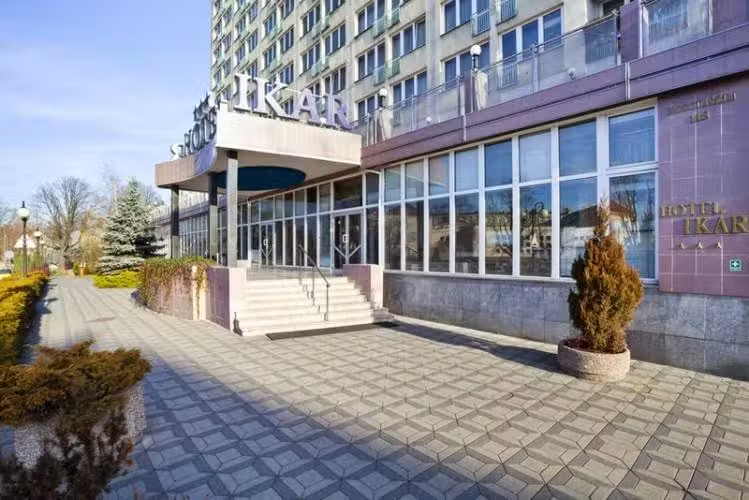
BackFor decades, the IKAR Hotel at 18 Solna Street has been a distinctive feature of Poznań's landscape. Built in the 1980s, it witnessed the political transformation and evolving guest expectations. Today, the facility is permanently closed, its history coming to an end, giving way to a modern project. Analyzing its activities based on numerous guest reviews and available information, a picture emerges of a place full of contrasts, one that has had as many ardent supporters as it has critics.
Location – an unquestionable advantage
The most frequently and almost unanimously praised aspect of Hotel IKAR was its location. Its central location, within easy reach of the Old Market Square, the Poznań International Fair, and the train station, made it an ideal base for both tourists and business travelers. For many people seeking accommodation in Poznań, the ability to reach key city attractions on foot was a decisive factor. An additional, frequently highlighted advantage was the ample parking – a valuable convenience in the crowded city center. It was this location that caused many people to overlook the hotel's other shortcomings.
Two worlds in one hotel: room lottery
The biggest problem and source of polarizing opinions about Hotel IKAR was the dramatically uneven standard of accommodations offered. Guests described their experience as being like playing the lottery – for the same price, one could either get a renovated room or a living open-air museum of a bygone era. This duality was frustrating and impacted the overall assessment of their stay.
A new, renewed face
Some guests were fortunate enough to find renovated rooms. They were described as clean, warm, comfortable, and fully equipped. A modern bathroom, working air conditioning, a refrigerator, and even a balcony were all standard features expected of a three-star hotel . For these guests, IKAR was a solid place to stay , offering good quality at a reasonable price.
A relic of the past
Unfortunately, an equally large, if not larger, group of guests had a completely different experience. They found themselves in rooms frozen in time in the 1990s or even earlier. Old, worn-out furniture, televisions older than the guests themselves, noisy lamps, and the lack of door handles to the balcony were just some of the shortcomings cited. There were also issues with a lack of hot water and a general feeling of filth. These worn-out rooms were a complete contradiction of the standards a hotel should offer and were the main reason for the low ratings. The lack of consistency in quality was the biggest drawback of this place.
Service – the human dimension of the hotel
The material shortcomings were countered by the staff, who received very positive reviews in most reviews. Guests often highlighted the courtesy, smiles, and helpfulness of the reception staff. It was the friendly service that sometimes mitigated negative impressions related to the technical condition of the room. However, these were exceptions, as some guests noted the lack of basic information upon check-in – about breakfast times, elevator location, or parking regulations. There were also complaints that, while the staff were friendly, they were sometimes helpless when faced with technical issues, such as a broken TV that took several days to repair.
Gastronomy: from Greater Poland cuisine to the canteen
The restaurant and its meals were another area that stirred strong emotions. On the one hand, there were very positive reviews praising the restaurant for serving excellent Greater Poland cuisine. On the other hand, many guests, especially regarding the breakfast, had devastating reviews.
- Breakfast: This was often described as the biggest disappointment. The buffet was often sparse, and the atmosphere resembled a staff cafeteria with an unpleasant odor. The lack of a coffee machine and the exclusive use of instant coffee pods in a hotel of this caliber were unacceptable to many guests. Although individual elements, such as the tasty scrambled eggs, were praised, the overall impression was negative.
- Restaurant: Breakfast aside, the hotel restaurant received better reviews, suggesting its potential was greater than the morning offerings might suggest.
Additional advantages and summary of experience
Besides its location, the hotel had several other advantages. One of these was the pet-friendly policy, which dog owners appreciated. For many, this was a key advantage, offsetting other drawbacks. The price-to-quality ratio, especially for the cheaper, older rooms, was often considered adequate – anyone looking for affordable accommodation in the city center and not having high expectations could be satisfied. It could be said that the older part of the IKAR functioned more like a hostería or albergue than a fully-fledged hotel.
The Final Chapter and the Future: From Icarus to Four Points by Sheraton
The history of the IKAR Hotel is inextricably linked to the Polish Hotel Holding. In recent years, the facility served important social functions – during the pandemic, it served as an isolation ward, and after 2022, it became a shelter for refugees from Ukraine. Ultimately, due to the need to adapt the building to modern building regulations and its overall technical condition, the decision was made to completely modernize it. The building was closed, and in its place, after a thorough renovation, a modern, four-star hotel operating under the international brand Four Points by Sheraton, part of the Marriott chain, will be built. The opening is planned for the end of 2026. The new hotel will offer 156 rooms, a conference center, and a restaurant, with interiors inspired by the aesthetics of Polish modernism and the 'modern vintage' style. This marks the definitive end of an era in Poznań's hotel industry and the beginning of a completely new chapter at 18 Solna Street.