Youth Hostel Pod Cisem
BackThe "Pod Cisem" Youth Hostel in Henryków Lubański is a facility that has become a permanent part of local tourism history, even though its operations have now ended. By examining its past, potential visitors and those interested in the region can understand its role and the void it has left behind. The most important piece of information, which should be emphasized from the outset, is that this facility is now permanently closed. Nevertheless, its history is worth sharing, as it provides an interesting example of an attempt to create specialized accommodations to meet the specific needs of tourists.
Origin and Mission: More than just a place to stay
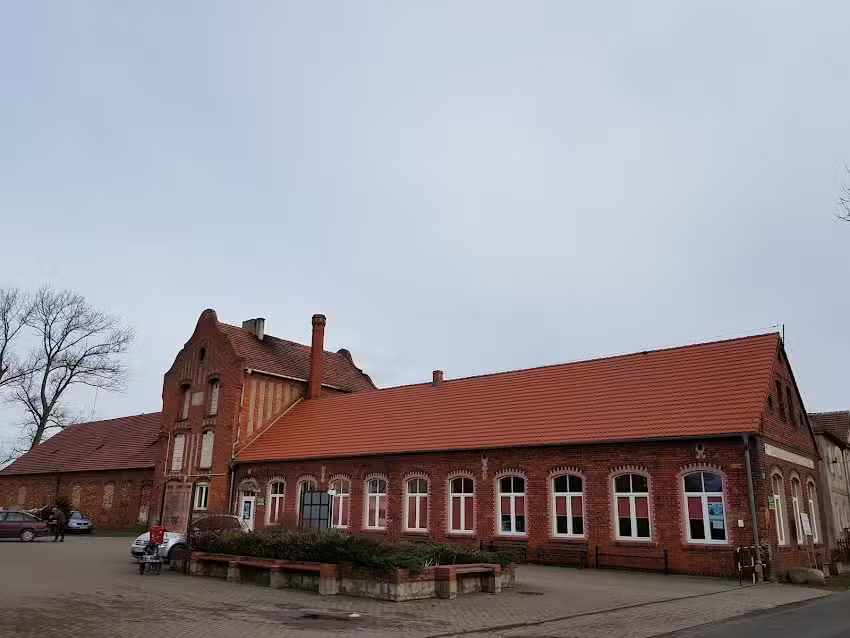
The facility in Henryków Lubański was not a typical hospedaje . Its creation was the result of a well-thought-out project aimed at utilizing existing infrastructure and capitalizing on the town's unique tourism potential. The shelter was established as part of the Regional Operational Program for the Lower Silesian Voivodeship for 2007-2013, through the conversion of a former village community center. This explains its simple, functional architecture, visible in preserved photographs. It was not a luxury resort or a complex of private villas , but a place with a clearly defined mission.
Its main purpose was to provide alojamiento for tourists and pilgrims following the Lower Silesian Way of St. James, which runs through Henryków Lubański. In this context, "Pod Cisem" served as a classic albergue, or pilgrim shelter, of the type often found on Spanish trails. An additional draw for guests was the proximity of the Henryków Yew, the oldest tree in Poland, estimated to be around 1,300 years old. The shelter's name was therefore a direct reference to this natural monument. It was the only youth hostel in the immediate area, making it a key location for affordable accommodations.
Conditions and amenities: What did the shelter offer?
According to official information and reviews from former guests, the "Pod Cisem" Youth Hostel offered accommodation for 20 people. This small number fostered the intimate atmosphere typical of hostales and youth hostels. The facility, classified as a category III youth hostel, was simple yet functional. Guests had access to a well-equipped, self-service kitchen and dining room, a key feature of a budget alojamiento , allowing for self-catering and further cutting travel costs.
Among the amenities that distinguished this place were a multimedia kiosk with maps and information about the Lubań commune and a special rack for 20 bicycles, a nod to cycling tourists. These details demonstrate that the facility's designers clearly understood the needs of their target group. Guest reviews confirm this image. The facility was praised for its cleanliness and low price. One review described it as "great for groups," suggesting it was a popular choice for school trips and organized tours, where the ability to accommodate larger groups in one place was important, rather than luxurious, individual accommodations.
Advantages and disadvantages from a guest's perspective
Positive aspects of the stay at "Pod Cisem"
The biggest advantage, highlighted in almost all available reviews, was the low price. In a world dominated by expensive hotels and vacation apartments , "Pod Cisem" offered an affordable alternative. It was a typical hostería , prioritizing functionality and accessibility over luxury. Guests also appreciated the cleanliness and friendly staff ("Nice people"), which is crucial in a communal setting.
- Economy: Extremely good value for money attracted tourists on a budget.
- Location: The location on the pilgrimage route and close to a unique natural monument was invaluable.
- Infrastructure: Access to a kitchen and facilities for cyclists were a real added value.
- Atmosphere: Places like this often foster integration and the exchange of experiences between travelers.
The limitations and realities of the shelter
Of course, this type of hospedaje wasn't for everyone. One review, rating the property three stars, mentions "full social." This term, though open to various interpretations, often refers to a very basic, even austere standard that may not appeal to those accustomed to the comforts offered by hotels or private departments . It should be assumed that the habitaciones were multi-occupancy, equipped with bunk beds and shared bathrooms—standard for such establishments. This was certainly not a luxurious establishment with waiter service or a quiet cabaña in the middle of nowhere. This was a vibrant, simple albergue where functionality and community were paramount.
Sad Finale: Permanent Closure
Despite a promising start, EU funding, and a clearly defined, needed market niche, the "Pod Cisem" Youth Hostel is currently listed as "permanently closed." Publicly available information doesn't specify the reasons for this decision. One can only speculate whether financial issues, maintenance issues, or a decline in interest were behind the closure. Regardless of the cause, it represents a significant loss for the local tourism scene. The closure has left a gap, particularly acute for pilgrims of the Way of St. James, for whom finding affordable and safe accommodation along the route is crucial. Tourists now seeking budget accommodation in the area must seek alternatives, which may be significantly more expensive or less conveniently located.
The story of the "Pod Cisem" mountain shelter is a tale of a place with great potential, which for a time successfully served a specific group of travelers. It proved that even a small town can create valuable tourism infrastructure, responding to European trends such as pilgrimage and cycling tourism. Although the shelter's doors are now closed, its existence is worth remembering as an important, albeit brief, chapter in the region's tourism history. Travelers planning a visit to Henryków Lubański must now turn their attention to other available accommodation options, such as local agritourism farms, guesthouses, or hotels in nearby Lubań.