
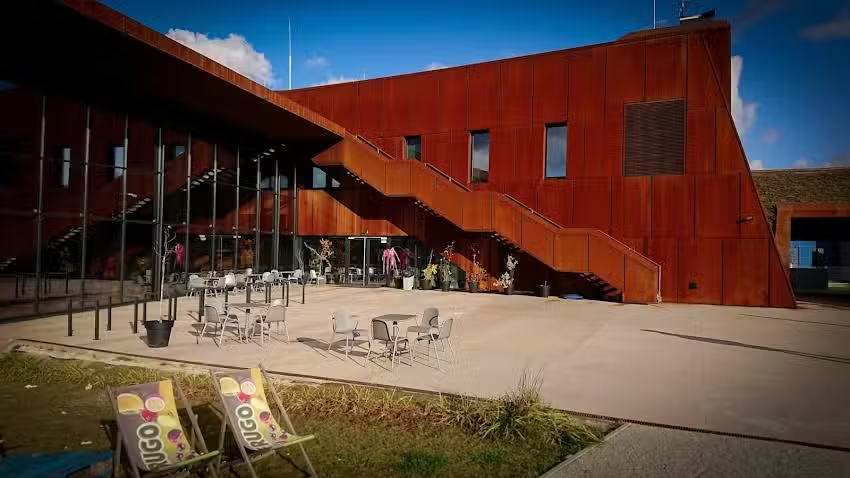
Hotel 17 rooms
BackHotel 17 Rooms, located at Aleja Marszałka Ferdynanda Focha 40 in Krakow, was a landmark hotel that briefly made its mark on the city's hotel scene before ultimately ceasing operations. The news of its permanent closure provides crucial context for any analysis of this location. Despite a relatively high rating of 4.6 based on over 130 reviews, the hotel 's history is complex and fraught with contradictions, worth examining to understand what gave it its potential and what ultimately contributed to its disappearance.
Unique Concept and Location Advantages
One of the greatest advantages of Hotel 17 Rooms was its location. Its location in the Zwierzyniec district, right next to Krakow's Błonia meadows, offered guests proximity to green spaces and recreational areas while also providing convenient access to the city center. The hotel itself was part of a larger complex – housed in the building of the KS Cracovia Centenary Hall and the Disabled Persons' Sports Center, giving it a unique, sporty character. This synergy was unusual and could attract a specific group of customers, including athletes and those who value active recreation. The architecture and interior design were in line with modern trends. Guests described the style as minimalist, even austere, with elements of concrete, which some appreciated, while others considered too cold. Regardless of their subjective impressions, most reviewers agreed on one thing: the interior was impeccably clean. The rooms were regularly described as very clean and well-maintained, providing a solid foundation for positive experiences.
Exemplary Accessibility for People with Disabilities
The most distinctive and widely praised aspect of Hotel 17 Rooms was its wheelchair accessibility. One guest in his review emphasized that the facility was "excellent," a crucial yet often inaccessible feature for many people with mobility limitations. Dedicated, fully accessible rooms and bathrooms were a huge plus. This feature allowed the hotel to fill a significant niche in the market, offering comfortable accommodation to a group of travelers whose needs are often marginalized. Even in deluxe rooms, the shower door could be removed and a chair added, demonstrating a flexible approach to guest needs. This commitment to creating barrier-free spaces was undoubtedly the hotel's greatest success.
Operational Problems and Weaknesses
Unfortunately, beneath the facade of modern design and laudable amenities, serious problems systematically undermined customer confidence. Service and management issues were the most frequently cited shortcomings, casting a shadow over the stay at Hotel 17 Rooms. One of the most egregious examples, described by one guest, was the cancellation of a reservation five days before arrival, despite having been made a month in advance. Such behavior is unacceptable in the hotel industry and demonstrates a profound lack of professionalism, placing potential customers in an extremely difficult situation. This experience demonstrates that even the best rooms cannot compensate for operational unreliability.
Other minor issues also impacted the overall experience. Limited reception hours (9 a.m. to 9 p.m.) presented a challenge for guests arriving late or departing early. There were also instances where, despite prior email confirmation, early check-in requests were denied and rooms were not ready. Some guests described the staff's attitude as "neutral" or unsmiling, which did not contribute to the friendly atmosphere expected in hospedajes .
Lack of Equipment and Comfort Rooms
Although cleanliness was excellent, and some guests praised the comfortable mattresses, which ensured excellent sleep, other aspects of the rooms' comfort left much to be desired. A common complaint was the lack of a kettle, a standard feature even in lower-rated properties such as hostales and albergues . Guests also complained about the very low room temperatures, which were incompatible with the outside conditions, suggesting problems with the heating or its improper regulation. The thick concrete walls, while providing some soundproofing, effectively suppressed cell phone signals, forcing guests to rely on the hotel's Wi-Fi. Other minor but irritating issues included difficulty setting the appropriate shower temperature and poorly contoured floors in the accessible bathrooms, which caused drainage problems. Furthermore, parking lot lights shining directly into the windows could disrupt sleep.
Additional Costs and Services
The pricing policy was also controversial. Paid parking, even for hotel guests, was widely criticized, with the 30 PLN per night rate considered excessive. At a time when many properties, from luxury villas to simple vacation apartments , offer parking included in the price of their stay, such a fee was seen as unjustified. Breakfast also received mixed reviews – described as "average" or "could be better." In an industry where the quality of the food and beverage offerings often determines guest return, this was another missed opportunity.
Summary: A Promising Project with Untapped Potential
The history of Hotel 17 Rooms is a case study of a facility with enormous potential that was not fully realized. On the one hand, it offered modern design, a great location, exemplary cleanliness, and, most importantly, exceptional accessibility for people with disabilities, which set it apart from the competition, including other hotels and resorts . On the other hand, its operations were plagued by fundamental operational issues: from unprofessional reservation management, to deficiencies in basic amenities, to controversial additional fees. The eventual closure of this establishment, although its direct causes are not publicly known, is not surprising given the feedback. This demonstrates that even the best concept and infrastructure cannot survive without solid management and attention to every aspect of the guest experience. Hotel 17 Rooms remains a memory of a place that could have been a jewel on the map of Krakow, especially as a disability-friendly resort , but stumbled over its own shortcomings.